One device that closes the whole loop
Detect, respond, record, and adapt, all inside one fan-less, pump-less, disinfectant-wipeable IP68 device. Here is how it works.
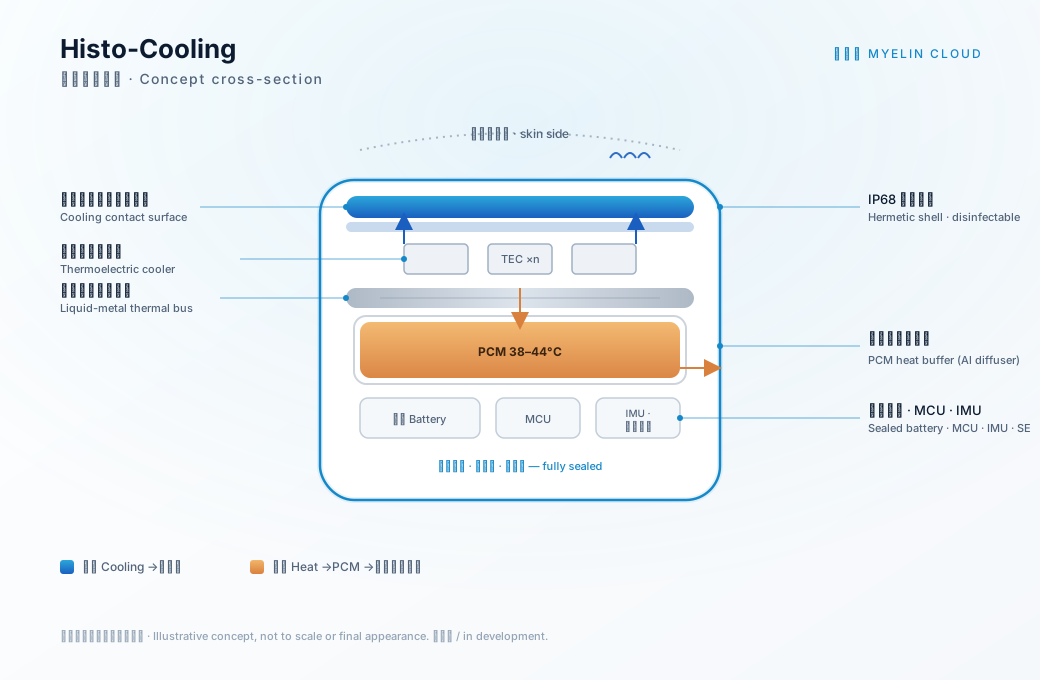
Concept cross-section: closed-loop response and a fully sealed passive-dissipation architecture (illustrative, not final appearance).
One sealed device closes the whole loop
Detect, respond, record, and adapt, all inside one fan-less, pump-less, disinfectant-wipeable IP68 device.
Detect scratch
IMU, sleep state machine, and frequency-domain analysis identify valid scratch episodes.
Active cooling
Cools the surface to break the itch-scratch cycle, bounded by a hard-coded safety envelope.
Signed data
Cryptographically signed time-series mapped to SCORAD / UAS7 / NRS endpoints.
Efficacy feedback
Adjusts intensity by whether the response worked, clamped to the safety envelope.
Three interlocking layers
Closed-loop method
A sleep state machine separates sleep states, frequency-domain analysis identifies valid scratch episodes, a closed-loop sequence triggers a response as it happens, and events map onto SCORAD / UAS7 / NRS endpoints.
Hermetic cooling
Thermoelectric modules cool, a liquid-metal thermal bus carries heat away from the contact surface, a phase-change material buffers peak heat, and the shell dissipates it passively. No fan, no pump, no vents; IP68 and disinfectable.
Trustworthy data
A hard-coded safety envelope bounds the response, a sham mode supports double-blinding, a device-unique key signs the data, export is offline and point-to-point, and storage is fault-tolerant.
Data sovereignty & privacy
Data never leaves the device unverified
Stored locally, no internet, no auto-upload; export is local and point-to-point on user initiation, signed by a device-unique key inside a tamper-resistant secure element, which makes it inherently PIPL- and data-localization-compliant.
Device at the edge, analysis in the cloud
The device is fully offline and signs data locally; "cloud" refers only to the authorized research-analytics platform that verifies signatures, computes endpoints, and runs multi-site dashboards. Edge capture and cloud research each do their own job.
Technical descriptions on this page are for technical and partnership communication. The product is in development and has no NMPA registration.